Table of Contents
Introduction
If you are looking for Chase CD rates today, understanding the available interest rates, account terms, and deposit requirements can help you decide where to put your savings chase cd rates today. JPMorgan Chase Bank offers certificates of deposit (CDs) that allow customers to deposit money for a set period and earn interest according to the account’s terms.
Chase offers standard CD rates and relationship rates for eligible customers who link a personal Chase checking account. The rate you receive depends on factors such as the CD term, deposit amount, and location. Because rates can change, it is important to check the bank’s current offer before opening an account.
This guide explains Chase CD rates, minimum deposits, relationship-rate eligibility, potential earnings, withdrawal penalties, and how to compare Chase with other banks.
What Are Chase CD Rates Today?
Chase CD rates vary by term and account eligibility. The bank offers CDs with terms ranging from short periods to several years, allowing savers to choose when they want their money to mature.
Chase has two main rate categories:
- Standard CD rates: Available under the bank’s standard account terms.
- Relationship CD rates: Available to eligible customers with a linked Chase personal checking account.
Recent rate comparisons have reported standard rates as low as 0.01% APY across many terms, while relationship rates can be substantially higher for selected terms. For example, a rate comparison published in October 2026 listed selected relationship rates of 3.50% APY for a seven-month CD and 3.00% APY for an 11-month CD for an example market and qualifying balances. These are illustrative local offers, not guaranteed nationwide rates.
For the most accurate quote, check the official Chase CD account page. Confirm the term, balance tier, relationship eligibility, and APY before opening an account.
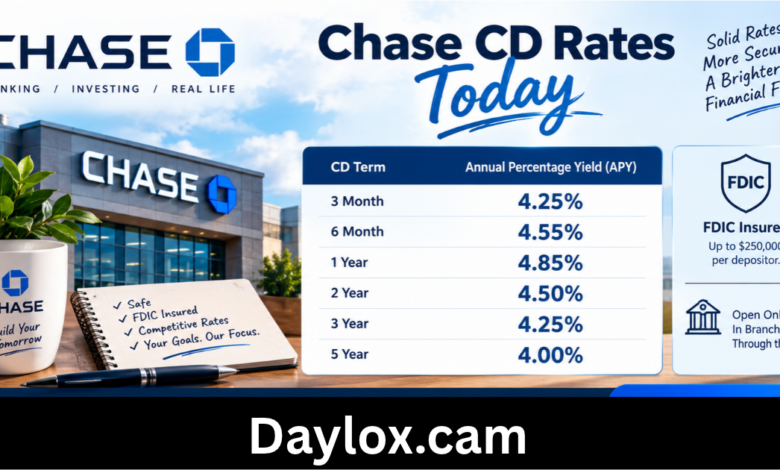
1. Chase CD Rates by Term
The annual percentage yield (APY) is an important figure when comparing certificates of deposit because it reflects the annualized return, including the effect of compounding.
The following table provides examples of selected Chase relationship rates reported for an example market in October 2026. Rates vary by location and may change before you apply.
| CD term | Example relationship APY |
|---|---|
| 3 months | 0.50% |
| 6 months | 0.50% |
| 7 months | 3.50% |
| 11 months | 3.00% |
| 12 months | 0.50% |
These figures are examples from a third-party rate comparison, not a nationwide rate promise. Your local Chase quote may be different, and standard rates are separate from relationship rates.
A shorter CD may be suitable if you expect to need the money soon. A longer term can provide more time for interest to accumulate, but it also means your funds may be inaccessible without a penalty. Compare the exact APYs offered for your location rather than choosing a CD based on its term alone.
2. What Is the Minimum Deposit for a Chase CD?
Chase generally requires a $1,000 minimum opening deposit for personal CDs. This makes the account accessible to savers who have some money set aside but may not want to commit a large amount.
Before opening an account, make sure the money you deposit is not needed for everyday bills, emergency expenses, or other short-term obligations. A CD is designed for money you can leave untouched for the agreed term.
The minimum deposit is only one part of the decision. A CD with a low APY may produce less interest than an alternative savings account, even if both products require similar starting balances.
3. How Chase Relationship CD Rates Work
Relationship rates are designed for customers who have an eligible personal Chase checking account linked to their CD. They can offer higher yields than standard rates for certain terms.
The difference between standard and relationship rates can be substantial. For that reason, customers should not assume that a rate advertised in a comparison article will automatically be available to them.
To evaluate a relationship offer, check whether you meet the eligibility requirements and whether the checking account has any monthly fees or balance conditions. Opening or maintaining another account solely to qualify for a CD rate may not be worthwhile if the costs outweigh the additional interest.
Chase’s rates can also differ according to location and deposit tier. Review the APY shown for your specific account before transferring money.
4. How Much Interest Can You Earn With a Chase CD?
Your potential earnings depend on the deposit amount, APY, and length of the CD. The following examples illustrate the approximate interest earned over one year, assuming the stated APY applies for the full period and the money remains deposited.
| Initial deposit | At 0.01% APY | At 3.00% APY | At 3.50% APY |
|---|---|---|---|
| $1,000 | $0.10 | $30 | $35 |
| $5,000 | $0.50 | $150 | $175 |
| $10,000 | $1 | $300 | $350 |
| $25,000 | $2.50 | $750 | $875 |
These are simplified one-year illustrations, not quotes for a particular Chase CD. A CD with a shorter term will not normally earn the full one-year amount shown, and actual interest depends on the account’s APY, term, and interest-payment arrangements. Taxes and applicable penalties are excluded.
The examples demonstrate why comparing the actual APY matters. Even a small difference in interest rates can produce a meaningful change in earnings when the deposit is large.
5. What Happens If You Withdraw Money Early?
Chase CDs are intended to remain open until maturity. If you withdraw principal before the maturity date, an early-withdrawal penalty generally applies.
For personal CDs, Chase’s published penalty schedule is based on the term:
- Terms shorter than six months: A penalty of 90 days of interest on the amount withdrawn, limited to the interest earned during the current term.
- Terms from six months to less than 24 months: A penalty of 180 days of interest on the amount withdrawn, limited to the interest earned during the current term.
- Terms of 24 months or longer: A penalty of 365 days of interest on the amount withdrawn, limited to the interest earned during the current term.
Additional rules may apply when a withdrawal takes place soon after opening the CD or making another principal withdrawal. The penalty can reduce the interest you earn and, depending on the circumstances, may reduce your principal.
Review the current deposit agreement before opening a CD. If you may need access to your savings at short notice, consider keeping emergency funds in an accessible account rather than placing all your cash in a CD.
6. Chase CDs vs. Other Banks
Chase offers the convenience of managing CDs alongside other banking services, particularly for customers who already use its checking accounts. However, convenience does not necessarily mean the highest available return.
Some online banks and credit unions offer competitive CD rates, sometimes with lower minimum deposits or different early-withdrawal conditions. Their offers can change frequently, so compare current APYs rather than relying on historical rates.
When comparing institutions, consider:
- The APY for the exact term you need.
- The minimum opening deposit.
- Whether the rate requires an existing checking account.
- Early-withdrawal penalties.
- Whether the institution is FDIC-insured or, for eligible credit unions, NCUA-insured.
- What happens when the CD reaches maturity.
A slightly higher APY may not be worth it if the account requires additional fees or does not fit your timeline. On the other hand, a large rate difference can justify comparing alternatives before committing your savings.
7. How to Open a Chase CD
Opening a Chase CD starts with reviewing the available terms and current rates.
Step 1: Check the Available Rates
Visit the official Chase CD page and review the standard and relationship rates. Use the rate applicable to your location, deposit amount, and eligibility.
Step 2: Choose a Term
Think about when you will need the money. Select a maturity date that fits your savings goal, whether you are setting aside funds for a planned purchase or building a predictable savings strategy.
Step 3: Confirm Eligibility and Deposit Requirements
Make sure you have the minimum opening deposit and understand any requirements for relationship rates. If you do not already have a Chase checking account, check how Chase handles opening a CD and qualifying for relationship pricing.
Step 4: Review the Agreement
Before funding the account, read the APY, maturity date, interest-payment rules, early-withdrawal penalty, and renewal options.
Step 5: Track the Maturity Date
Chase provides a 10-day grace period after a CD matures. During this period, customers can generally make changes to the matured CD, such as withdrawing funds or selecting another term. Check the maturity notice for the options and deadlines applicable to your account.
Frequently Asked Questions About Chase CD Rates Today
1. What are Chase CD rates today?
Chase rates depend on the CD term, deposit amount, location, and whether you qualify for relationship rates. Check Chase’s official CD page for the current APY available to you.
2. What is the minimum deposit for a Chase CD?
Chase generally requires $1,000 to open a personal CD. Confirm the current account terms before applying.
3. Does Chase offer higher CD rates to checking customers?
Yes. Eligible customers with a linked Chase personal checking account may qualify for relationship rates that are higher than standard rates on selected terms.
4. Are Chase CD rates fixed?
A CD’s APY is generally fixed for the agreed term once the account is opened. The rate offered to new customers can change before you open an account.
5. Can I withdraw money from a Chase CD early?
Early withdrawal is generally subject to a penalty. The penalty depends on the CD term and can reduce your interest earnings or principal.
6. Are Chase CDs FDIC-insured?
Eligible Chase deposit accounts, including CDs, are FDIC-insured up to applicable limits. Standard FDIC coverage is generally $250,000 per depositor, per insured bank, for each account ownership category. Review FDIC rules if your combined deposits approach that amount.
7. Are Chase CD rates better than online banks?
Not always. Some online banks and credit unions offer higher APYs. Compare the rates for the same term, minimum deposit, and account conditions before deciding.
Conclusion
Chase CD rates today vary according to the term, deposit amount, location, and eligibility for relationship pricing. While the bank offers convenient savings options for existing customers, the standard rates and relationship rates can differ considerably. Before opening an account, chase cd rates today check the latest APY on Chase’s official website, calculate the interest you could earn, and review the early-withdrawal penalty. Compare other banks and credit unions as well to see whether a better rate is available for your savings timeline.