
Table of Contents
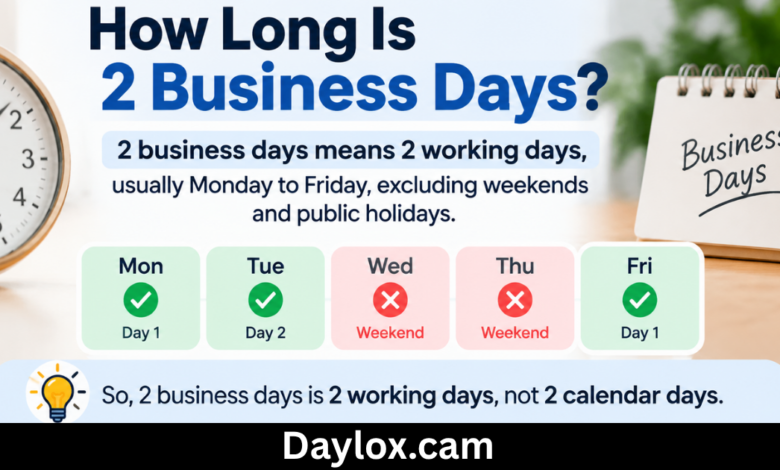
Understanding how long is 2 business days can be important when waiting for a payment, delivery, bank transfer, application, refund, or business response. Unlike calendar days, business days generally exclude weekends and, in many cases, public holidays.
In most situations, 2 business days means two working days, usually Monday through Friday. However, the exact time can depend on when the counting begins, the organization’s working schedule, and whether a public holiday falls within the period.
What Does 2 Business Days Mean?
Two business days generally refer to two days when a company or organization is officially operating. For a standard Monday-to-Friday schedule, Saturday and Sunday are normally not counted as business days.
For example, if something is processed on Monday and the organization starts counting from the next working day, Tuesday is the first business day and Wednesday is the second. Therefore, two business days can often mean approximately 48 working hours, although it does not necessarily mean exactly 48 consecutive hours.
How Long Is 2 Business Days in Calendar Days?
The calendar length of two business days depends on which day you start counting.
If the period begins on Monday, two business days are typically Tuesday and Wednesday, meaning the deadline may arrive on Wednesday. If the period begins on Friday, the weekend can extend the calendar period, making the second business day Tuesday.
Here is a simple example:
| Starting Day | 1st Business Day | 2nd Business Day |
|---|---|---|
| Monday | Tuesday | Wednesday |
| Tuesday | Wednesday | Thursday |
| Wednesday | Thursday | Friday |
| Thursday | Friday | Monday |
| Friday | Monday | Tuesday |
This example assumes a normal Monday-to-Friday workweek and no public holidays.
Does the Starting Day Count as a Business Day?
Whether the starting day counts depends on the wording used by the company or service provider. Some organizations begin counting from the day an order or request is received, while others begin counting on the next business day.
For example, if a company says how long is 2 business days a request will be completed within 2 business days, a request submitted during business hours on Monday may be completed by Tuesday or Wednesday, depending on the company’s specific processing policy.
When an exact deadline matters, check whether the organization counts the submission day.
How Weekends Affect 2 Business Days
Weekends how long is 2 business days make two business days take longer in calendar time. Saturday and Sunday are generally not considered business days for organizations that operate on a traditional Monday-to-Friday schedule.
For example, if a business receives a request on Friday and counts the following working days, Monday would normally be the first business day and Tuesday would be the second. The weekend therefore creates a four-calendar-day gap from Friday to Tuesday.
Some businesses operate seven days a week, so their definition of a business day may be different.
How Public Holidays Affect 2 Business Days
Public holidays can also affect the calculation. A public holiday that falls on a normal working day is usually excluded from the business-day count.
Suppose Monday is a public holiday. If a request is submitted on Friday and the organization does not operate on weekends or Monday, Tuesday may become the first business day and Wednesday the second.
Because public holidays vary by country and organization, checking the relevant holiday calendar can help determine the actual deadline.
Examples of How Long 2 Business Days Can Take
Two Business Days Starting on Monday
If counting begins after Monday, Tuesday is the first business day and Wednesday is the second. In this situation, the period generally ends on Wednesday.
Two Business Days Starting on Friday
For a standard Monday-to-Friday business, Saturday and Sunday are skipped. Monday becomes the first business day and Tuesday becomes the second.
Two Business Days With a Public Holiday
If a public holiday occurs during the period, that day may not count. This can move the expected completion date further into the week.
Why Companies Use Business Days
Businesses commonly use business days because many services depend on employees, banks, payment networks, shipping departments, or government offices operating during normal working periods.
For example, a company may state that a refund takes 2 business days because its accounting department only processes refunds on working days. Similarly, a bank transfer may involve processing schedules that do not operate continuously throughout weekends and holidays.
Using business days provides organizations with a consistent way to communicate expected processing periods.
How to Calculate 2 Business Days Correctly
To calculate how long is 2 business days, follow these simple steps:
- Identify the date when the process starts.
- Check whether the starting date is counted.
- Skip weekends if the organization follows a Monday-to-Friday schedule.
- Skip applicable public holidays.
- Count two qualifying working days.
- Check the organization’s stated cutoff time or processing policy.
This method works for many common situations, including deliveries, payments, refunds, applications, and customer-service requests.
2 Business Days vs. 2 Calendar Days
How long is 2 business days is an important difference between business days and calendar days. Two calendar days simply means two consecutive dates, regardless of whether they fall on a weekend or holiday.
Two business days normally means two qualifying working days. As a result, two business days can take more than two calendar days.
For example, a two-calendar-day period beginning Friday can reach Sunday, while two business days may extend to Tuesday under a traditional how long is 2 business days-to-Friday schedule.
Frequently Asked Questions
Is 2 business days the same as 48 hours?
Not necessarily. Two business days represent two working days rather than exactly 48 consecutive hours. Weekends, holidays, business hours, and processing cutoffs can affect the actual elapsed time.
How long is 2 business daysDoes Saturday count as a business day?
Usually, how long is 2 business days does not count for businesses that operate Monday through Friday. However, some companies and industries operate on Saturdays, so their policies may differ.
Does Sunday count as a business day?
Sunday is generally not considered a business day for a standard Monday-to-Friday organization. Businesses with weekend operations may use a different definition.
Does a public holiday count as a business day?
How long is 2 business days, no. If an organization is closed for a public holiday, that day normally does not count toward a business-day period.
If something starts Friday, when are 2 business days?
For a typical Monday-to-Friday schedule, Monday is usually the first business how long is 2 business days and Tuesday is the second, assuming Friday itself is not counted as the first day.
Can 2 business days mean three or four calendar days?
Yes. Weekends and public holidays can make a two-business-day period longer when measured in calendar days.
Do banks use the same definition of a business day?
Not always. Banks and financial institutions can have specific business-day definitions and daily processing cutoffs. Their terms and conditions should be checked for an exact deadline.
What if a company says “within 2 business days”?
The phrase generally means the company expects to complete the task within two qualifying working days. However, the precise interpretation can how long is 2 business days on the company’s stated terms, cutoff times, and operating schedule.
Conclusion
So, how long is 2 business days? In a standard Monday-to-Friday schedule, it generally means two working days, but the exact calendar period depends on the starting date, weekends, public holidays, and the organization’s counting rules.
For the most accurate answer, always check whether the starting day counts and whether the company has special business hours or processing cutoffs. This is especially important when dealing with payments, refunds, applications, deliveries, or other time-sensitive services.