
Table of Contents
Introduction
Understanding U.S. Bank CD rates can help savers make informed decisions about where to keep their money and how to earn predictable returns. u.s. bank cd rates A certificate of deposit (CD) is a savings product that generally offers a fixed interest rate for a specific period in exchange for keeping funds deposited until maturity.
For readers researching U.S. Bank CD rates through Daylox, this guide explains how CD accounts work, the different options available, minimum deposit requirements, early withdrawal penalties, and the factors to consider before opening an account.
Because interest rates can change, checking the bank’s official website for current offers is essential before making a financial decision.
What Are U.S. Bank CD Rates?
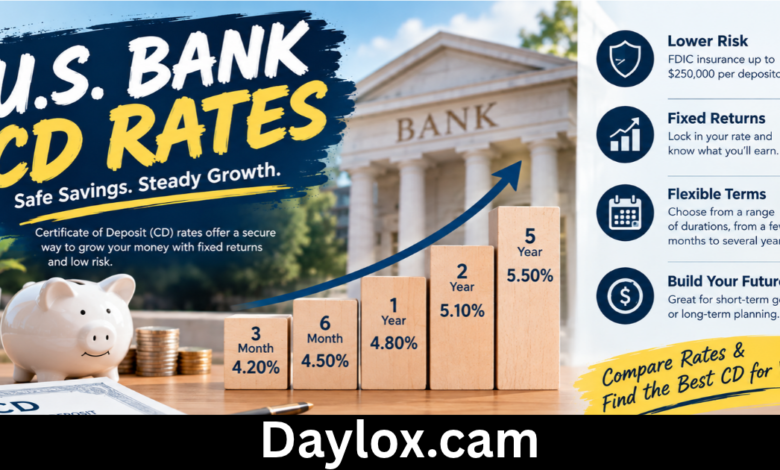
U.S. Bank CD rates determine how much interest customers can earn on money deposited into a certificate of deposit. The bank offers different CD products with varying terms, rates, and opening deposit requirements.
The annual percentage yield (APY) measures the total interest earned over one year, taking compounding into account. A higher APY generally means greater potential earnings when comparing accounts with similar conditions.
U.S. Bank’s advertised CD rates may vary according to the selected term, deposit amount, location, and promotional eligibility. Some rates may also be available only to qualifying new CD customers.
You can review current offers directly on the official U.S. Bank CD rates page.
Types of U.S. Bank CDs
U.S. Bank provides several CD options designed for different savings goals.
1. Standard CD
A Standard CD is a traditional certificate of deposit with a selected term and a rate established when the account is opened. U.S. Bank lists a minimum opening deposit of $500 for this product.
This option may suit savers who want a straightforward account and know they will not need the deposited money before maturity.
2. CD Special
The CD Special is a promotional product designed to offer competitive rates on eligible deposits. The published terms specify a $1,000 minimum opening deposit, with online eligibility restrictions applying to certain customers.
Promotional rates can vary by location and term. Existing U.S. Bank customers may need to sign in to view personalized offers.
3. Step Up CD
A Step Up CD features scheduled interest-rate increases during its term. U.S. Bank describes a 28-month option with a rate increase every seven months.
This structure may appeal to savers who prefer a product with predetermined rate adjustments rather than a single unchanged rate throughout the term.
4. Trade Up CD
A Trade Up CD allows an eligible customer to take advantage of a qualifying rate increase during the term, subject to the product’s rules.
It may be worth considering when future interest rates are uncertain, but customers should review the initial rate, available adjustment options, and withdrawal restrictions before deciding.
How Much Can You Earn With a U.S. Bank CD?
Your earnings depend on the deposit amount, APY, term length, and applicable account conditions.
For example, suppose you deposit $10,000 into a hypothetical CD earning 3.00% APY for one year. If the funds remain deposited for the entire year, the account would grow to approximately $10,300.
This is an illustration, not a current U.S. Bank rate quote. Actual earnings depend on the APY offered when you open the account and the CD’s terms.
When comparing rates, remember that a higher APY does not automatically make an account the best choice. A shorter term may offer greater flexibility, while a longer term may provide more certainty about the rate for an extended period.
Factors to Consider Before Opening a CD
Minimum Deposit
Check the minimum opening balance before applying. U.S. Bank lists $500 for Standard CDs and $1,000 for CD Specials, Step Up CDs, and Trade Up CDs in its published product information. Confirm the requirements for the specific offer you choose.
Term Length
CD terms can range from short periods to several years, depending on the product. Choose a term that matches when you expect to need the money.
Early Withdrawal Penalties
CDs generally restrict access to deposited funds before maturity. Withdrawing money early may trigger a penalty that reduces your earnings and, depending on the circumstances, could reduce your principal.
Rate Changes
Traditional CDs generally lock in the agreed rate during the initial term. Promotional rates and renewal rates can change, so check the applicable disclosures before opening or renewing an account.
FDIC Insurance
U.S. Bank states that its eligible deposit accounts, including CDs, are FDIC-insured up to the applicable legal limits. Standard FDIC coverage is generally up to $250,000 per depositor, per insured bank, per ownership category.
How to Open a U.S. Bank CD
Opening a CD typically involves a few straightforward steps:
- Visit the official U.S. Bank website.
- Enter your ZIP code to view rates available in your area.
- Compare CD products, terms, APYs, and minimum deposits.
- Review the eligibility requirements and account disclosures.
- Complete the application and fund the account if you qualify.
If you already bank with U.S. Bank, sign in to check whether personalized promotional rates are available.
Before confirming your account, review the maturity date, renewal conditions, interest payment schedule, and early withdrawal penalty.
Frequently Asked Questions
1. What are the current U.S. Bank CD rates?
Rates vary by location, product, deposit amount, and term. Visit the official U.S. Bank CD rates page for the latest available APYs rather than relying on an outdated rate table.
2. What is the minimum deposit for a U.S. Bank CD?
U.S. Bank lists a $500 minimum for Standard CDs and a $1,000 minimum for CD Specials. Other products have their own requirements, which should be confirmed before applying.
3. Are U.S. Bank CDs FDIC-insured?
Yes. Eligible U.S. Bank CDs receive FDIC protection up to the applicable limits, generally $250,000 per depositor, per insured bank, per ownership category.
4. Can I withdraw money before my CD matures?
Early withdrawals may be permitted under the account terms but usually involve a penalty. Review the agreement carefully before depositing money you may need soon.
5. Do U.S. Bank CDs automatically renew?
Many CDs automatically renew unless you provide different instructions. Check the maturity notice and grace-period deadline so you can withdraw funds or change your instructions when permitted.
6. Is a CD better than a regular savings account?
A CD may provide a predictable rate in exchange for restricted access to funds. A regular savings account generally offers more flexibility. The better choice depends on your liquidity needs and the rates available.
7. Can existing U.S. Bank customers receive promotional CD rates?
Potentially. Eligibility depends on the offer and the bank’s conditions. Existing customers should sign in to online banking or contact the bank to review available personalized offers.
Conclusion
U.S. Bank CD rates can help savers compare fixed-term deposit options and plan for predictable interest earnings. Standard CDs, CD Specials, Step Up CDs, and Trade Up CDs each have different features, minimum deposits, and conditions. u.s. bank cd rates Before opening an account, compare the current APY, term length, early withdrawal penalties, renewal rules, and eligibility requirements. The most suitable CD is one that balances potential earnings with your need for access to cash.